This blog was created as a venue for printmakers in Malaysia to come together and share ideas, information and facilities.
We also would like to create awareness, spread the love for printmaking!
Sunday, 18 November 2012
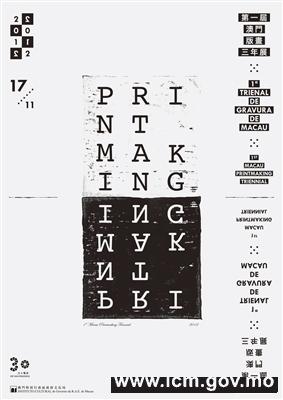
The Opening - 1st Macau Printmaking Triennial
Can u spot the Malaysian team? Prof Rahman (far left), Kim Ng, Wong Siew Lee, Frank Woo and Loo Foh Sang (on the stairs)
The one of the winning entries...
(Sorry to be so brief. More report later. Uploading from a temperamental wi-fi access)
After the Opening yesterday, the Malaysian team will be taking the ferry to Shekou, enroute to Shenzhen City. Today, we hope to take in OCT Contemporary Art and Loft Area.
Tomorrow will be a visit to Guanlan Printmaking Base and Dafen Oil Painting Village.
Bye now.. Checking out!
Thursday, 15 November 2012
Macau, here we come!
After days and weeks of preparation,..we r now meeting up at LCCT to head for Macau.
The organisers have generously put us up at the Riviera Hotel (formerly Ritz Hotel) up on Pena Hill, with a beautiful view of the long & elegant bridges in Macau (that's what i read online). Excited to see the place. We will be landing at Macau airport in Taipa. It's right out in the sea!
Macau consists of Macau Peninsula, Taipa Island (below it) and Coloane Island (further down). Now, there is additional land mass, ie. reclaimed land between Taipa & Coloane, called Cotai Strip where huge, opulent casinos reside.
I picked up a book yesterday at Borders, The Curve. It's not the usual guide book. It's called "Strolling in Macau". The right book for us, because besides the Welcome Dinner (16 Nov), Opening Ceremony (17 Nov 5pm), followed by Celebration Dinner, its a free & easy time for the artists.
So this book, which first outlines the history of Macau (written with all the juicy bits) gives a step by step guide for a walkabout. Cant wait to try it out!
![]() |
| Riviera Hotel |
Macau consists of Macau Peninsula, Taipa Island (below it) and Coloane Island (further down). Now, there is additional land mass, ie. reclaimed land between Taipa & Coloane, called Cotai Strip where huge, opulent casinos reside.
I picked up a book yesterday at Borders, The Curve. It's not the usual guide book. It's called "Strolling in Macau". The right book for us, because besides the Welcome Dinner (16 Nov), Opening Ceremony (17 Nov 5pm), followed by Celebration Dinner, its a free & easy time for the artists.
So this book, which first outlines the history of Macau (written with all the juicy bits) gives a step by step guide for a walkabout. Cant wait to try it out!
Wednesday, 7 November 2012
Exh. opening : TRANSIT A4 @House of Matahati
A Page, a record of an encounter.
Walking down the street, all you come across is a complicated configuration of almost everything within a vast space; from peoples, buildings, to animals and all sorts of signs and marks, familiar and yet peculiar sometime; randomly arrayed without much consideration but intentionally.
A Page sets as a documentation of social facet through visual presentation collected from the living surrounding, both real and converted.
Walking down the street, all you come across is a complicated configuration of almost everything within a vast space; from peoples, buildings, to animals and all sorts of signs and marks, familiar and yet peculiar sometime; randomly arrayed without much consideration but intentionally.
A Page sets as a documentation of social facet through visual presentation collected from the living surrounding, both real and converted.
Catch TRANSIT A4, Nov 10, 8pm at HOM, Ampang and the show will runs until Nov 20, 2012
| Kim Ng
A Page / 2012 / Water based paint, transfer print collage, silkscreen
print, embossed paste,threads & varnish on canvas / 21 x 29.7 cm
|
Friday, 19 October 2012
Bidding for participation in 4th Guanlan International Print Biennial 2013
Guanlan International Print Biennial has been successfully conducted 3 times by Guanlan Original Printmaking Base. Now the 4th in 2013 is forthcoming. We attained big success in the previous 3 biennials due to the great support of the artists from the entire world. This exhibition will focus on artistic and academic ability, and promote the creative and individual work style. A high level and superior quality of art works will be selected for the exhibition.
We also hope that the Guanlan International Print Biennial will promote the exchange of artists around the world and endeavour that Guanlan International Print Biennial becomes the platform and window for people from the world to understand China, also for Chinese to understand the world.
We invite you to participate in this exhibition, and sincerely hope that more and more artists come from different countries to participate in this exhibition and to see numerous great print art works.
DEADLINE for receiving works : FEBRUARY 25, 2013.
Exhibition place : Guanlan Original Printmaking Base, Shenzhen,China
Exhibition period : Mid May - Mid June, 2013
Number of proposed works : 200 - 300 pieces
- Submitted works of each artist are limited to 1 or 2 original work of print created in the last two years prior to the exhibition. All print techniques will be accepted. The works should be signed and do not need to be mounted.
- The size of the largest for the submitted works is 120×120cm and the smallest is 30×30cm. A set of work consist of two or three separate prints (such as triptych) which also cannot surpass this limit.
For more details: http://www.guanlanprints.com/b
Please forward this news to others who may interested.
Thank you very much.
Sincerely
Zhao Jiachun
Secretary to Curator
*******************************************************************
NOTE to interested artists. If u can't access the website but would like to have more information and Entry Form, pls email: acgmalaysia@gmail.com
We also hope that the Guanlan International Print Biennial will promote the exchange of artists around the world and endeavour that Guanlan International Print Biennial becomes the platform and window for people from the world to understand China, also for Chinese to understand the world.
We invite you to participate in this exhibition, and sincerely hope that more and more artists come from different countries to participate in this exhibition and to see numerous great print art works.
DEADLINE for receiving works : FEBRUARY 25, 2013.
Exhibition place : Guanlan Original Printmaking Base, Shenzhen,China
Exhibition period : Mid May - Mid June, 2013
Number of proposed works : 200 - 300 pieces
Please forward this news to others who may interested.
Thank you very much.
Sincerely
Zhao Jiachun
Secretary to Curator
*******************************************************************
NOTE to interested artists. If u can't access the website but would like to have more information and Entry Form, pls email: acgmalaysia@gmail.com
Tuesday, 16 October 2012
Countdown to the 1st Macau Printmaking Triennial begins!
In exactly 1 month's time, our Malaysian team of printmakers will arrive at Macau, including their writer/blogger (me) and another ACG member (Kak Siti) will start our 6D5N trip which will include Shenzhen too.
The Macau exhibition organisers are arranging our accomodation and itinerary. They are also publishing the exhibition catalog - bilingual (English & Mandarin). This will include a 5000-word from each participating country documenting the development of printmaking in their country! Gonna be a thick book :)
As this is the first major publication of my writing, i'm thrilled to bits! All this is attributed to Frank Woo, who introduced to me this project and Prof Rahman, who helped check & wrote the concluding section.
It's also a tribute to ACG - The Arts & Crafts Guild KL & Selangor who celebrates it's 19th anniversary this 31st October. ACG was conceived as a vehicle to help promote artists and crafters alike. It's membership is open to all who practice creative pursuits and also all who appreciate the creative outputs of artists, crafter, designers, theatre performers, sculptors, ..etc and of course printmakers.
Printmaking is 'new' & little known to our members and the public. but fortunately, it is part of the syllabus for Fine Art courses in colleges & universities. ACG is committed to raising awareness about this artform and it has started with the creation of this blog. It is open to ALL PRINTMAKERS IN MALAYSIA. Much still has to be done.
After the Macau exhibition and visit to Guanlan Printmaking base in Shenzhen, ACG will organise a slide presentation & discussion about our experiences there. This is the purpose of my trip - to document the 'printmaking' experiences and promote Malaysian printmakers.
So the countdown begins!
The Macau exhibition organisers are arranging our accomodation and itinerary. They are also publishing the exhibition catalog - bilingual (English & Mandarin). This will include a 5000-word from each participating country documenting the development of printmaking in their country! Gonna be a thick book :)
As this is the first major publication of my writing, i'm thrilled to bits! All this is attributed to Frank Woo, who introduced to me this project and Prof Rahman, who helped check & wrote the concluding section.
It's also a tribute to ACG - The Arts & Crafts Guild KL & Selangor who celebrates it's 19th anniversary this 31st October. ACG was conceived as a vehicle to help promote artists and crafters alike. It's membership is open to all who practice creative pursuits and also all who appreciate the creative outputs of artists, crafter, designers, theatre performers, sculptors, ..etc and of course printmakers.
Printmaking is 'new' & little known to our members and the public. but fortunately, it is part of the syllabus for Fine Art courses in colleges & universities. ACG is committed to raising awareness about this artform and it has started with the creation of this blog. It is open to ALL PRINTMAKERS IN MALAYSIA. Much still has to be done.
After the Macau exhibition and visit to Guanlan Printmaking base in Shenzhen, ACG will organise a slide presentation & discussion about our experiences there. This is the purpose of my trip - to document the 'printmaking' experiences and promote Malaysian printmakers.
So the countdown begins!
Wednesday, 19 September 2012
Prints have arrived at Macao!
AUG 30...
"Confirm received 8 applications and the article. Thanks a lot!
We’ll have a welcome dinner on 16 Nov evening, and the opening ceremony schedule at 17:00 on 17Nov."
... from the Printmaking Triennial organisers
And so... the excitement begins.
To date, most of the 8 Malaysian artists have booked their flights with a return flight from Shenzhen, our stopover after Macau. They will be visiting the Guanlan Printmaking Centre at Shenzhen.
Check some of the blogs on this centre :
China's Printmaking City of Guanlan
The blogger comments : Never one to be outdone in anything, China decided to set up an artists' colony for printmakers. In specific, the Guanlan Centre.... The wonderful thing about
this place is that it’s not just a building or two that is called an
artist colony. The Center makes up a whole village! Guanlan is a 300
year old (ancient by western standards) Hakka fishing village, and in
2008, it was converted into a studio center for printmakers! How
Excellent!
...Unlike the surrounding cities,
the Guanlan Original Print Base is in a peaceful ecological zone. From
the studios the artists overlook vegetable - and strawberry fields. While they harvest one field, they plant new seedlings on the next. From morning to
evening they work in the fields, watering the
plants with two cans at the same time, which are hanging from a bamboo
stick over both shoulders. The fields are surrounded by brooks and ponds
with frogs and ducks, bridges and footpaths. The artists live in 300
years old Hakka village houses. They are built from stone. Wooden galleries and heavy doors are carefully restored. There are watch towers and decorated pe
diments mirror in the diverse lakes.
The print base began with it’s
residency program in May 2009. Before they
had already held two biennuals and art fairs. They will build a printing
museum in the next three years.
diments mirror in the diverse lakes. Shenzhen Guanlan Print Original Base
The entrance of Print Artist
Village at Shenzhen Guanlan Print Original Industry Base on November 21,
2008. [Photo: CRIENGLISH.com/ Xu Liuliu]
Located northeast of Guanlan Town in Shenzhen, the
Guanlan Print Original Industry Base is the spiritual home of Chen
Yanqiao, a pioneer in contemporary Chinese printmaking. The Print Base
is jointly set up by the Shenzhen Bao'an District People's Government,
the China Artists Association and the Shenzhen Federation of Literary
and Art Circles. It includes printmaking works, exhibitions, background
information and research on the fine art. The three parties offer a
platform for academic and commercial development by working on five
projects including the Guanlan International Print Biennial, a Print
Workshop, and the Original Print Fair. The Print Base also provides
ecological and artistic inspiration for visitors who come to appreciate
the works of the famous artists, the ancient Hakka houses and unique
local customs.Printmaking residency in Guanlan
A Guest Post by Evan Summer
In May and June 2010 I was an Artist in Residence at the Guanlan Print Original Industry Base in Guanlan, China. After participating in the 2007 and 2009 Guanlan Biennial Print Exhibitions, they invited me to be an artist in residence. I’ve never traveled much but knew I’d regret it if I didn’t take advantage of this opportunity.
The residencies are usually between three weeks and three months. During that time artists are expected to produce prints in any of the four standard areas: etching, serigraphy, lithography and relief. They are provided with studios, basic supplies, 24/7 access to the workshop and the help of technicians.
*********************************************************************************
NOTE : I originally wanted to post about Macau... but after learning about Guanlan... you can see (from links above) why I'm now sooo eager to visit this place!!
Sunday, 9 September 2012
Dasein's Printmaking studio
Frank asked me to help pick up Kim Ng's print for the Macao exhibition and so i headed for Sri Rampai LRT station. Dasein Academy of Art is housed in a few shoplots near Wangsa Walk.
Kim was a gracious host. He took me straight to the studios where we chatted about printmaking in Malaysia. Then he took me around all the studios in the Fine Art Dept.
Dasein's printmaking studio :
Drawing & Ceramic studios :
Kim was a gracious host. He took me straight to the studios where we chatted about printmaking in Malaysia. Then he took me around all the studios in the Fine Art Dept.
Dasein's printmaking studio :
Drawing & Ceramic studios :
Thanks, Kim..
Sunday, 2 September 2012
Visit to Terap Ulang Studio, Universiti Sains Malaysia, Penang
I like the name Terap Ulang. "Terap" refers to press, undergoing a pressing process (ie printmaking) and "Ulang" means to repeat. Hence, it is named "Repeated Pressed". Such a creative and perfect name to describe the energy the students and lecturers have creating prints.
SAFETY first / Precautions / Procedures :
Looking at the signages around the studio / workspace, i cant help wonder whether the parents would have allowed their undergrad sons & daughters take up this disciplin,e..if they knew! ha ha.. Just in jest.
But, seriously, whenever your are using tools and chemicals (even in home science class where u can get scalded by hot oil), one must RESPECT the tools & chemicals.
Also goes to show the dedication of printmakers. Hazardous fumes, danger of spills, ..are all part of printmaking.
TOOLS of the trade
Printing presses - either manually operated or automated, Just press a button & it slowly rolls the print plate & paper into the machine and out.
DRYING rack Once it is setup, the printing press must be run uninterupted to print as many prints as u want. Some choose do a few copies, some up to hundreds and others only, a monoprint (single). This rack helps separate the prints as the ink is still wet.
QUIZ 1 - What's this picture showing??
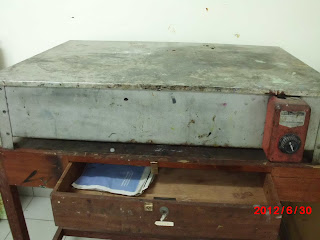
And this ?
---> Can anyone help?. Pls write in your comments below. Picture A & B
Now we come to the next studio :
INK roller
Wow..that's a huge & heavy roller. Here, Prof Rahman is showing me how to ink the block. Looks like you got to be strong & fit too to do printmaking. Well that's putting to good use the muscles u gain from gym workouts.
STONE lithography
This also requires heavy lifting. Some of the stone blocks are so large, they even have a forklift to carry it to the press. It's from imported limestone. Just how is stone lithography done?
When u finish using this image on the stone, how do u remove the image to make another... You dligently and meticulously grind it off!
QUIZ 2 -
Can u explain how these TWO machines work?
Picture C & D
HANDMADE paper source
This patch of banana trees provide raw materials for handmade paper making, another printmaking 'resource'.
Definitely a WELL-EQUIPPED PRINTMAKING STUDIO..
| This is the first thing u see on entering the first studio.
|
SAFETY first / Precautions / Procedures :
Looking at the signages around the studio / workspace, i cant help wonder whether the parents would have allowed their undergrad sons & daughters take up this disciplin,e..if they knew! ha ha.. Just in jest.
But, seriously, whenever your are using tools and chemicals (even in home science class where u can get scalded by hot oil), one must RESPECT the tools & chemicals.
Also goes to show the dedication of printmakers. Hazardous fumes, danger of spills, ..are all part of printmaking.
| Manual printing press |
| Automated printing press (for the older ones..says Prof. Rahman) |
Printing presses - either manually operated or automated, Just press a button & it slowly rolls the print plate & paper into the machine and out.
| Drying rack |
| Picture A |
| Picture B |
---> Can anyone help?. Pls write in your comments below. Picture A & B
Now we come to the next studio :
INK roller
Wow..that's a huge & heavy roller. Here, Prof Rahman is showing me how to ink the block. Looks like you got to be strong & fit too to do printmaking. Well that's putting to good use the muscles u gain from gym workouts.
STONE lithography
This also requires heavy lifting. Some of the stone blocks are so large, they even have a forklift to carry it to the press. It's from imported limestone. Just how is stone lithography done?
When u finish using this image on the stone, how do u remove the image to make another... You dligently and meticulously grind it off!
QUIZ 2 -
Can u explain how these TWO machines work?
Picture C & D
| Picture D |
| Picture C |
HANDMADE paper source
This patch of banana trees provide raw materials for handmade paper making, another printmaking 'resource'.
Definitely a WELL-EQUIPPED PRINTMAKING STUDIO..
An essay for Macau exhibition catalogue
This an ambitious and bold step towards the better understanding of printmaking among countries in the region.
Printmaking has a long and interesting history in every country. It would be educational & informative to know more about it. So, for the 1st Macao Printmaking Triennale - exhibition catalogue, each country
was asked to submit a 5000 word essay about the development of artistic
printmaking in their country.
I was given the task to research and write the essay. A daunting task, as I very new to this genre but i dived in with full energy for it's been a long time since I've done any academic research. I camped at the National Visual Art Gallery (formerly known as NAG)'s resource centre & National Library's Malaysiana section and googled the net . Juhari Said's website had very useful articles. I was also lucky to get the help of Prof Rahman Mohamed, Dean of School of Arts, Universiti Sains Malaysia in Penang. Frank Woo gave (lent) me his collection of printmaking exhibition catalogues with articles about printmaking history that were invaluable. Kim Ng (Ng Kim Peow) showed me around his Printmaking studio @Dasein Academy of Arts (near Wangsa Walk, Mangsa Maju). He heads the Fine Art Dept. at Dasein. He was the only one to answer to my email questionnaire about the situation of printmaking in Malaysia, in the last 5 years. Also spoke to Suzlee Ibrahim, head of Aswara's Fine Arts Dept. on the phone and he very gallantly gave me his views and encouragement.
And so, with much thought, reading, writing and re-writing the essay (at one point) almost ran amok beyond the 5K word quota. Much information keep coming in and re-writing was the order of the day. And i had an extra hurdle - i kept spelling names wrongly!, especially if they were mentioned many times in the essay. So in my very, very final draft, i proof-read the essay concentrating only on the names. The writing went past a 'famous' event, the Olympic badminton finals, which i missed (although, technically i was sitting a few metres from the tv monitor.). It also survived past the fasting month and Hari Raya celebrations. When i made a trip to USM to collaborate with him on the essay, we talked/discussed for hours during the late morning till afternoon. He also had to work during the Raya celebrations, checking my work (as he is a printmaker himself) and writing the conclusion.
But all in all, it was one of the most intense, yet enriching experience, thanks to all who help and various capacities. Cant wait to read about the other printmakers in other countries!
Contemporary printmaking in China started in the 1930s, but due to the restrictive conditions of the time, priority was given to the woodcut. After the founding of New China the situation changed out of all proportion. Not only was printing established in the academies as a specialist area of study but, as well as woodcut printing workshops, lithography and intaglio workshops were starting to be set up.
The Japanese are well-known for its " 木版画, moku hanga" (woodblock printing method) which is best known for its use in the ukiyo-e artistic genre. Although similar to woodcut in western printmaking
in some regards, the moku hanga technique differs in that it uses
water-based inks—as opposed to western woodcut, which often uses
oil-based inks. The Japanese water-based inks provide a wide range of
vivid colors, glazes, and transparency.
Contemporary printmaking came to India in 1556, about a hundred years after Guttenberg's Bible was first printed. There is, however, evidence that the use of the concept of mass
duplication dates even further back in India, to the time of the Indus
Valley Civilization. For instance, grants of land were originally
recorded by engraving the information on copper plates and etchings on
different surfaces like wood, bone, ivory and shells have been
documented as an important craft of that time. Nevertheless, printmaking
as a media for artistic expression, as it is recognized today, emerged
in India less than eighty years ago.
Silpakorn University, Thailand's
first fine arts university, was established in 1943 by Silpa
Bhirasri (Professor Corrado Feroci), an Italian artist who came
to Thailand in 1923 at the request of King Rama VI. The university was the country's first institution
to offer a program in printmaking. It was instrumental in establishing
the print category at The National Art Exhibition an annual event
which celebrated its 48th anniversary this year. Begun by Prof.Bhirasri
in 1949, The National Art Exhibition, awarded its first printmaking
prizes at the 12th annual competition in 1961.The print works displayed over the years have received a tremendous
amount of interest and attention. This has encouraged artists
and professors at Silpakorn University to raise the level of
their teaching and their artistic output, and as a result, a
number of local printmakers today enjoy a reputation that extends
far beyond the borders of Thailand!
(taken from various websites - click the country links to read more)
I was given the task to research and write the essay. A daunting task, as I very new to this genre but i dived in with full energy for it's been a long time since I've done any academic research. I camped at the National Visual Art Gallery (formerly known as NAG)'s resource centre & National Library's Malaysiana section and googled the net . Juhari Said's website had very useful articles. I was also lucky to get the help of Prof Rahman Mohamed, Dean of School of Arts, Universiti Sains Malaysia in Penang. Frank Woo gave (lent) me his collection of printmaking exhibition catalogues with articles about printmaking history that were invaluable. Kim Ng (Ng Kim Peow) showed me around his Printmaking studio @Dasein Academy of Arts (near Wangsa Walk, Mangsa Maju). He heads the Fine Art Dept. at Dasein. He was the only one to answer to my email questionnaire about the situation of printmaking in Malaysia, in the last 5 years. Also spoke to Suzlee Ibrahim, head of Aswara's Fine Arts Dept. on the phone and he very gallantly gave me his views and encouragement.
And so, with much thought, reading, writing and re-writing the essay (at one point) almost ran amok beyond the 5K word quota. Much information keep coming in and re-writing was the order of the day. And i had an extra hurdle - i kept spelling names wrongly!, especially if they were mentioned many times in the essay. So in my very, very final draft, i proof-read the essay concentrating only on the names. The writing went past a 'famous' event, the Olympic badminton finals, which i missed (although, technically i was sitting a few metres from the tv monitor.). It also survived past the fasting month and Hari Raya celebrations. When i made a trip to USM to collaborate with him on the essay, we talked/discussed for hours during the late morning till afternoon. He also had to work during the Raya celebrations, checking my work (as he is a printmaker himself) and writing the conclusion.
But all in all, it was one of the most intense, yet enriching experience, thanks to all who help and various capacities. Cant wait to read about the other printmakers in other countries!
Malaysian printmakers invited to Macao
Malaysian will be one of 11 countries to participate in the 1st Macao Printmaking Triennial organised
by the Cultural Affairs Bureau of the Macao SAR Government and
co-organised by the Printmaking Research Centre of Macao. This 1st Macao
Printmaking Triennial will be held in November this year. With the aim
of encouraging the creation of printmaking works and facilitating the
exchange of culture and arts within Asia, the Triennial has invited a
jury of renowned Asian artists to confer awards such as “Best Creation”
and other distinctions on selected participants. The prizes are very
attractive, with the “Special Award” offering a purse of MOP 100,000.
Macao has a unique historical reason for hosting this first ever joint exhibition of Asian printmaking: in its role as a gateway between East and West, Macao was the point of entry into China for copper plate printmaking and Western movable type technologies.
Artists from the Chinese Mainland, Hong Kong, Macao and Taiwan, as well as Japan, South Korea, Singapore, Thailand, Malaysia, Vietnam and India have been invited to participate in the Triennial. A quota of eight works from each country or region will be selected for the exhibition and will be candidates for the “Best Creation” award and other distinctions. The exhibition has set aside a special zone for works produced within the Chinese Mainland, Hong Kong, Macao and Taiwan to showcase the newest facets of contemporary printmaking in Greater China.
The veteran local printmaking artists Wong Cheng Pou, Sou Pui Kun and Fung Pou Chu have submitted their recent work on special invitation from the Cultural Affairs Bureau, and the Macao Region’s quota of eight will be filled by an additional eight local artists, screened and selected from submissions received in the last week of August.
Macao has a unique historical reason for hosting this first ever joint exhibition of Asian printmaking: in its role as a gateway between East and West, Macao was the point of entry into China for copper plate printmaking and Western movable type technologies.
Artists from the Chinese Mainland, Hong Kong, Macao and Taiwan, as well as Japan, South Korea, Singapore, Thailand, Malaysia, Vietnam and India have been invited to participate in the Triennial. A quota of eight works from each country or region will be selected for the exhibition and will be candidates for the “Best Creation” award and other distinctions. The exhibition has set aside a special zone for works produced within the Chinese Mainland, Hong Kong, Macao and Taiwan to showcase the newest facets of contemporary printmaking in Greater China.
The veteran local printmaking artists Wong Cheng Pou, Sou Pui Kun and Fung Pou Chu have submitted their recent work on special invitation from the Cultural Affairs Bureau, and the Macao Region’s quota of eight will be filled by an additional eight local artists, screened and selected from submissions received in the last week of August.
Wednesday, 22 August 2012
A venue for Malaysian printmakers...
![]() |
| 'Equator' by A. Rahman Mohamed |
Today is the start of our new blog called PRINTMAKING MALAYSIA, dedicated to all artistic printmakers in Malaysia
It is an extension of our main blog, ACGMALAYSIA.blogspot.com, the home of The Arts and Crafts Guild, KL & Selangor.
We welcome anyone, artists / organisations / institutions / students who have an interest in this exciting artform to contribute by sending
- News of their print exhibition in Malaysia or abroad
- Articles they have written or read about printmaking in Malaysia
- Pictures of their work with a Title, Year, Concept and description of Techniques used so that their work can be appreciated by those who visit this blog
Subscribe to:
Posts (Atom)